
Diver Stories – NB Divers Seoul
From Hobby to Divemaster
MiYeong’s Story
A denim designer who started with a try dive and never stopped – how Han Mi-Young became a PADI Divemaster and why she chose to learn the right way in Korea.
Diver Profile
Every Diver Has a Beginning
Some people discover the ocean through a snorkelling trip on holiday. Others fall in with a group of friends who already dive. And some – like Han Mi-Young – step into a pool for a try dive on a quiet afternoon, feel weightless for the first time, and never quite come back to the surface.
MiYeong is a freelance denim designer living in Seoul. During the week, her days are filled with fabric meetings, client briefs and the structured rhythm of the fashion world. But on weekends – and on every dive trip she can squeeze between projects – she transforms. Underwater, she is present in a way that no meeting room can replicate.
Her journey from curious beginner to PADI Divemaster is the kind of story we love telling at NB Divers. It is not about talent or speed. It is about consistency, curiosity, and choosing to invest in proper training at every stage.
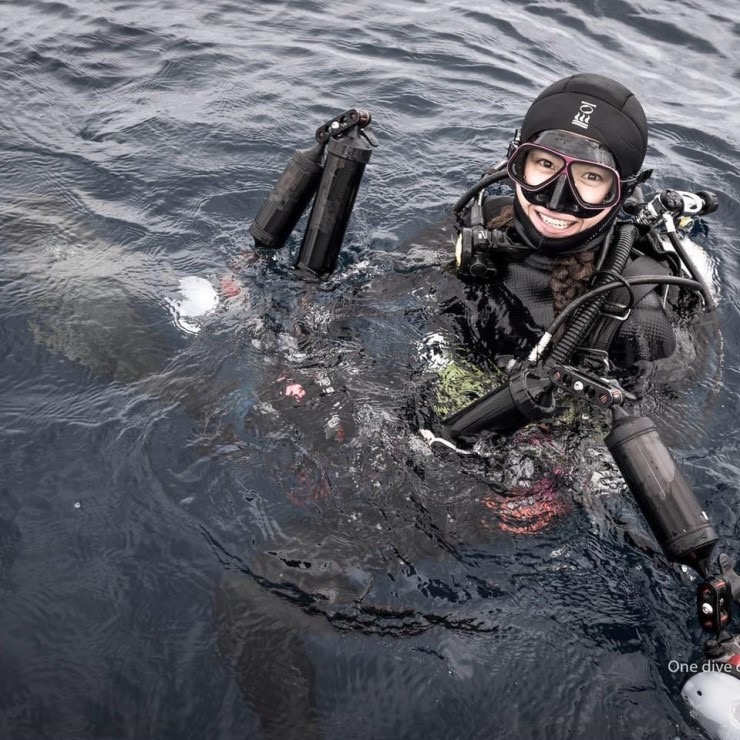
Han Mi-Young
PADI Divemaster · NB Divers
A freelance denim designer and passionate underwater photographer. MiYeong began diving in 2009, earned her PADI Open Water in 2010, and progressed through Advanced, Rescue, and Divemaster certifications – all while holding down a full-time creative career. Currently preparing for her PADI Instructor Development Course (IDC).
The Certification Path
A Decade-Long Journey,
Done Right
MiYeong’s path is a masterclass in patient, deliberate progression. She never rushed a certification, never skipped a level, and eventually switched to PADI because she wanted her dives to be recognised anywhere in the world.
Discover Scuba Diving
Her first breath underwater – a try dive that started everything. The moment of weightlessness in the pool was enough to change the entire direction of her weekends.
PADI Open Water Diver
Completed her initial Open Water certification and began exploring Korea’s coastal dive sites. At this stage, diving was still a weekend hobby rather than a calling.
PADI Advanced Open Water
Made the decision to switch fully to the PADI system and re-certified at Advanced level. From this point forward, every course was with PADI – for global recognition and consistent standards.
PADI Rescue Diver + EFR
Emergency First Response and Rescue Diver are prerequisites for Divemaster. MiYeong describes these as two of the most transformative courses she took – they shifted her focus from enjoying dives to protecting them.
PADI Divemaster ✓
The first professional-level PADI certification. As a Divemaster, MiYeong can lead certified divers and assist instructors with training courses. Her next goal: PADI Open Water Scuba Instructor (OWSI).
– Han Mi-Young, PADI Divemaster
In Her Own Words
The Interview
We sat down with MiYeong to hear her story in full – from her first breath underwater to the moments that shaped her as a diver and the advice she has for anyone standing on the edge of the pool, wondering if it’s for them.
01.What do you do for work?
I’m a freelance denim designer. My days are mostly meetings and client calls – a rhythm that repeats unless I’m diving. Diving is the one thing that breaks that cycle completely. The moment I drop below the surface, work stops existing.
02.Describe a typical workday when you’re not diving.
Office in the morning, client meetings in the afternoon, repeat. It’s a good life, but it can feel very closed. That’s probably why diving means so much to me – it’s the one space where no one can call, message or deadline me. It’s pure presence.
03.When did you start diving?
I did a try dive in 2009. Just to see what it was like. I remember coming up from that first pool session and thinking – I need to keep doing this. So in 2010, I signed up properly for my Open Water certification. That was the beginning of everything.
04.How did you progress to PADI Divemaster?
I started with a Korean national certification body for Open Water in 2010. Then in 2014, I decided to switch to PADI – starting from Advanced Open Water and working my way up. PADI made sense because it’s recognised everywhere. From Advanced, I went to Rescue Diver, Emergency First Response, and then Divemaster. It took time, but each level felt earned.
05.What did it feel like to earn your Divemaster certification?
Honestly? Like a different kind of diver woke up inside me. When I first started, diving was just exciting. But as I went through the professional training, I started understanding the physics, the physiology, what’s actually happening when you breathe compressed air at depth. That knowledge gave me confidence I didn’t know I was missing. And confidence made the dives better.
06.Which course did you enjoy most and why?
Underwater photography. Without question. I already loved taking photos above the surface, but underwater everything is different – the light behaves differently, subjects don’t stay still, buoyancy affects your framing. It was harder than I expected, but the PADI SEA method (Shoot, Examine, Adjust) gave me a real framework. The moment I got a shot I was truly proud of, I understood why so many divers call it their favourite specialty. I still carry a camera on every dive.
07.Are you active as a PADI professional now?
I am currently working as a Divemaster and preparing for my PADI Instructor Development Course. The IDC has been on my mind for a while. I want to teach – not as a full career, but because I want to be the person who shows someone their first breath underwater and gives them the same feeling I had in 2009.
08.What is your most treasured memory from diving?
Every dive is vivid in memory – the ocean doesn’t let you forget. But Taiwan stands out. I dived ancient coral formations that had been growing for a thousand years. And at night, there was a stretch of water where bioluminescence made it look like the Milky Way was beneath us, not above. I tell every new diver: get your certification and go to Taiwan. It will change your understanding of what beauty means.
09.What advice would you give to someone considering their first PADI certification?
It might feel easy to some people and genuinely difficult to others – and both are normal. What matters is that you do not give up easily. The skills that feel uncomfortable in the pool are the ones that keep you safe in the open ocean. Trust the process, trust your instructor, and trust that it gets easier and more beautiful with every dive.
10.Final words for aspiring divers?
Three things. First: be humble before the ocean – it is always bigger than your confidence. Second: protect what you dive in – love the sea enough to leave it exactly as you found it. Third: choose a dive school where they teach you honestly and thoroughly. A short course that cuts corners will cost you more in the long run than a proper education done once, done right. Start at the right place. You’ll know the difference the moment you’re underwater.
The Underwater Photographer’s Eye
Capturing Korea’s
Hidden Oceans
MiYeong’s love of underwater photography is inseparable from her passion for Korea’s own dive sites. While many divers dream of the Maldives or the Red Sea, she insists that the seas around Korea offer some of the most photogenic and underrated diving in Asia.
The East Sea (Sea of Japan), in particular, rewards photographers willing to tolerate cold water. Visibility can exceed 20 metres in autumn and winter, and the colder temperatures mean the water holds more oxygen – resulting in rich marine life that would surprise anyone expecting tropical blandness. Nudibranchs, dense kelp forests, crags draped in soft coral, and the occasional leopard shark make for a completely different visual language than tropical reefs.
– Han Mi-Young
The PADI Digital Underwater Photographer specialty – which MiYeong counts among her favourites – is available at NB Divers as part of any continuing education pathway. Whether you shoot with a compact camera in a housing or a dedicated underwater system, the same principles apply: composition, buoyancy control, and the patience to let the subject come to you.
For MiYeong, it was the combination of this specialty and diving Korea’s own waters that turned a weekend hobby into a decade-long commitment.
Diving in Korea
Why Korea Is One of Asia’s
Best Places to Get Certified
MiYeong’s story is partly a story about Korea itself. She could have gone to Thailand or the Philippines for a fast certification in warm water. Instead, she learned in Seoul – in NB Divers’ controlled pool environment with small-group instruction – and that choice shaped the quality of her training.
Korea is an underrated destination for scuba education. NB Divers, based in Seoul, operates one of the country’s only PADI Career Development Centres – the highest tier of PADI recognition. Students learn in a 5-meter indoor pool before progressing to open-water sessions in the East Sea, Jeju Island or designated inland sites. Every standard is met because every standard matters.
For expats and foreigners living in Seoul, the question is often: “Can I get PADI certified in Korea with English instruction?” The answer at NB Divers is yes. Classes are conducted in both Korean and English, and the team has experience teaching international students from dozens of countries. The PADI certification you earn here is identical to one earned anywhere else in the world.
If you are in Korea – whether you’re a resident or just visiting – and you have ever been curious about diving, MiYeong’s story is a useful reminder: it is never too late, and the right school makes all the difference.
Frequently Asked
Questions About
PADI Divemaster & Diving in Korea
What is a PADI Divemaster and what can they do?
A PADI Divemaster is the first professional-level certification in the PADI system. Divemasters can lead certified divers on guided dives, assist PADI instructors with training courses including Open Water and Discover Scuba Diving programs, supervise diving activities, and conduct dive briefings. It is the stepping stone toward the PADI Instructor certification, and it represents a significant shift from recreational diver to dive professional.
What are the requirements to become a PADI Divemaster?
To enrol in the PADI Divemaster course, you must be at least 18 years old, hold PADI Rescue Diver certification (or equivalent), hold Emergency First Response certification within the past 24 months, have a physician-signed medical statement within the past 12 months, and have at least 40 logged dives to begin training – 60 dives are required to complete the certification. Advanced Open Water Diver certification is also a prerequisite.
How long does PADI Divemaster training take?
Most divers complete the PADI Divemaster course in 4 to 8 weeks, depending on the pace of training and how quickly they accumulate the required 60 logged dives. The course involves knowledge development sessions, in-water skills training, assisting with actual student divers, and written assessments. Some candidates working full-time spread the training over several months, as MiYeong did.
What is the PADI Digital Underwater Photographer specialty course?
The PADI Digital Underwater Photographer specialty teaches you how to choose the right camera system, apply the PADI SEA method (Shoot, Examine, Adjust) to refine your shots underwater, compose images effectively, and manage buoyancy while shooting. The course involves at least two dives with your instructor. It counts toward your Master Scuba Diver rating and is one of the most popular PADI specialty courses worldwide. Prior to enrolment, you need to be at least a Junior Open Water Diver.
Is Korea a good place to learn scuba diving?
Yes. Korea is an excellent place to get PADI certified, particularly if you want high-quality small-group instruction in a structured environment. Seoul’s NB Divers operates a 5-metre indoor pool for confined water training, ensuring that all foundational skills are built correctly before students proceed to open water. Korea also offers diverse open-water dive sites – the East Sea (cold, clear, with rich marine life), Jeju Island (warmer, with tropical influence), and several dedicated inland dive sites. Learning in Korea means building cold-water competence from the start, which makes you a more capable diver globally.
Can tourists and expats get PADI certified in Korea?
Absolutely. NB Divers in Seoul welcomes international students for all PADI courses, from Open Water to Divemaster. If you are an expat living in Korea, you can complete a full certification pathway here. If you are visiting Korea for a shorter period, Discover Scuba Diving experiences are available, and it is also possible to complete the eLearning component of your Open Water course before arriving and finish the in-water training during your stay. Contact us to discuss what is possible within your schedule.
Do dive schools in Korea teach in English?
NB Divers conducts classes in both Korean and English. Our instructors and staff are experienced in teaching international students, and all PADI materials are available in English. PADI certifications are globally standardised, so the qualification you earn at NB Divers in Seoul is identical in every way to one earned in Thailand, Australia, or the United States.
How does learning to dive in Korea compare to Thailand or the Philippines?
All three countries offer excellent PADI training. Thailand and the Philippines offer warm, clear water and abundant marine life that makes early dives visually rewarding. Korea offers something different: structured, methodical training in a controlled environment with experienced instructors who emphasise skill quality over speed. Cold-water dives in the East Sea build a level of equipment confidence and thermal management that warm-water divers often lack. Many divers who train in Korea find that they are significantly more comfortable when they travel to tropical sites because they have already dealt with the harder conditions at home.
How many dives do I need to start the PADI Divemaster course in Seoul?
You need a minimum of 40 logged dives to begin the PADI Divemaster course, and 60 logged dives to complete it. If you are not yet at that level, NB Divers can help you build your dive count through guided dives in Korea and organised dive trips to domestic and international sites. Contact us to discuss a progression plan tailored to your current certification level and available time.
What dive sites are available for training and fun diving around Seoul and Korea?
NB Divers regularly takes students and certified divers to sites including Yangyang and Goseong on the East Sea coast, Jeju Island for boat dives in warmer southern waters, and several inland pool and quarry sites for skills practice. The East Sea is particularly well regarded for cold-water macro photography, with nudibranchs, kelp forests, soft coral, and visibility that can reach 20 metres. Jeju offers more typical recreational diving conditions with warmer water, colourful reefs, and occasional large pelagics. See our Dive Korea page for more.
Your Story Starts Here
Ready to Begin?
MiYeong started with a single try dive. You can too. Whether you want to explore scuba for the first time or you are ready to commit to a full PADI certification, NB Divers is Korea’s premier PADI Career Development Centre – and we teach every student like their first dive is the only thing that matters.
